
user locations: pete_nice
boston tea party site
from american revolution, boston tea party posted in history by pete_nice
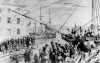
On December 16, 1773, a large gathering of colonists had a heated exchange at the Old South Meeting House in Boston. The subject was what to do with the three British ships (the Dartmouth, Eleanor, and Beaver) that were loaded down with tea and moored at Griffin’s Wharf.
Samuel Adams said the phrase, "Gentlemen, this meeting can do nothing more to save the country." Later, this was interpreted as a signal (still under debate) for a group of 30 to 130 men, some dressed in Mohawk warrior disguises, to board the ships three dump all 342 chests of tea into the water. The Boston Tea Party (as it was renamed in 1834) was over in three hours.
The exact location of Griffin's Wharf has been disputed over the subsequent years. A plaque is located at this address and affixed to the Independence Wharf building to commemorate the occasion. However, this blogger makes a pretty convincing argument for the 500 Atlantic Ave location (the Intercontinental Boston building).
 view full location details...
bunker hill monument
from american revolution, freedom trail posted in history by pete_nice
Fought on June 17, 1775, the battle of Bunker Hill pitted an untrained American militia against a battle-hardened British army. Since the Americans had little gunpowder and ammunition, the famous line "Don't fire until you see the whites of their eyes" was uttered at this battle as a pragmatic order.
Out of the 2,200 British troops at the battle, almost half (1,034) were counted afterwards as casualties (both killed and wounded). The Americans lost between 400-600 combined casualties.
Also killed during this battle was the popular American patriot, Major-General Dr. Joseph Warren, who was killed during the third and final assault.
Today, Bunker Hill has a 221-foot granite obelisk to mark the first site of the first battle of the American Revolution, and is on the Boston Freedom Trail.
 view full location details...
uss constitution
from american revolution, us navy posted in history by pete_nice
Named by George Washington and launched on September 20, 1797, the USS Constitution is currently the world's oldest commissioned naval vessel afloat.
The USS Constitution has been a part of national identity since its creation. Paul Revere fashioned the copper bolts and and later the copper sheeting that adorned its sides (which helped earn the nickname "Old Ironsides").
The ship saw battle against the Barbary pirates of Algeria, a moment that was later reworked into the "Marine's Hymn" ("...to the shores of Tripoli").
The Constitution saw action in the War of 1812, the Civil War, and several other battles. Today, it is a destination on the Boston Freedom Trail.
 view full location details...
sleepy hollow cemetery
from washington irving posted in literature by pete_nice
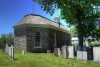
Built in 1849, the Sleepy Hollow Cemetery is the final resting place for many notable Americans, including the author of "The Legend of Sleepy Hollow" and "Rip Van Winkle", Washington Irving (1783–1859).
The churchyard of a colonial-era church, built here in 1684 by Dutch settlers, is the setting for Irving's "Sleepy Hollow" story. It's also where the headless Hessian horsemen is buried...
William Rockefeller (1841–1922), New York head of the Standard Oil Company, is buried at Sleepy Hollow. So is Leona Helmsley (1920–2007), who famously bequeathed $12 million to her dog.
 view full location details...
woodlawn cemetery
from herman melville posted in literature by pete_nice
On November 14, 1851, Moby-Dick was published for the first time in New York. The book was written by Herman Melville and was rooted in his own experiences in the US Navy and as a merchant marine in the South Seas.
Herman Melville died in 1891, and is buried in Woodlawn Cemetery.
 view full location details...