

At a dinner awhile back, I was trying to provoke a reaction from an artist and author by asking if she considered her recent work as “postmodern.” The reaction was immediate and visceral, with several people wincing. “I hate that word,” said a friend attending art school. “It sounds so art school-y.”
Like the alternative category label for music, postmodern is a clumsy and imprecise word. By the very structure of their usage, they connote some sort of overall “accepted” form of the described art form that alternative or postmodern works are deviating from. The labels immediately dilute the importance or originality of a work, dismissing it categorically as derivative, or worse, reactionary.
That being said, we need labels and categories to make life easier, even crude and inaccurate ones. I’m not exactly sure if the following buildings should be considered postmodern, post-postmodern, neomodern, or some other form. The intention of this post isn’t to make an argument for inclusion into a specific category; it’s to point out some obvious and interesting similarities in Minneapolis’ starchitect collection.
The Frederick R. Weisman Art Museum, located on the University of Minnesota Campus, was designed by Frank Gehry and completed in 1993. Situated on a bluff overlooking the Mississippi River, the Weisman stands like a gleaming Palace of Oz, reflecting the sun off its stainless steel exterior. With an addition completed in 2011 (also by Gehry), the Weisman has a rotating collection of modern (or postmodern) art. Gehry received the Pritzker Prize (architecture’s version of the Nobel) in 1989 and is easily one of the most recognized architects living today.
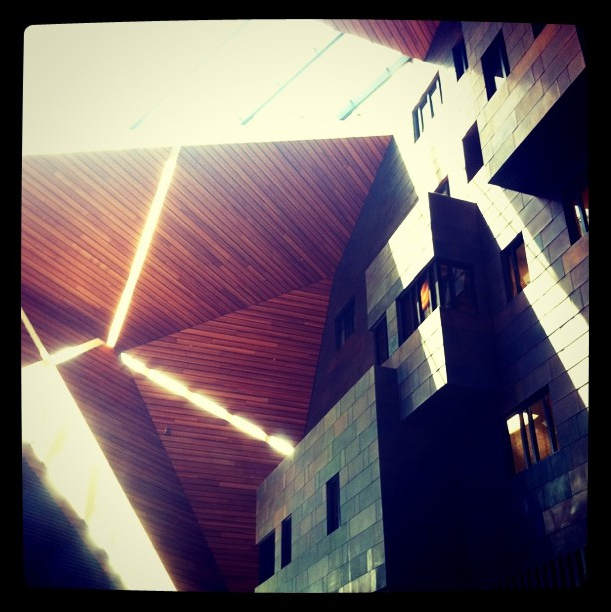
Also on the U of M campus is the McNamara Alumni center. New Mexico-based architect Antoine Predock began the design in 1996, and KKE Architects provided the executive architect and general manager roles for the construction. Completed in 2000, McNamara is intended to resemble a geode sheathed in granite and copper, with irregular windows and slits of glass providing interior illumination. Inside the structure, Memorial Hall is an enormous six-story, 85 ft. room that provides a gathering space, presumably to bask in the grandeur. The band Incubus shot their video “Drive” in Memorial Hall and received an MTV Video Award nomination in 2000 (the song is pretty awful, but the interiors are interesting).
The new Guthrie Theater, sitting on the banks of the Mississippi River, was the first American design by French architect Jean Nouvel. Completed in 2006, the Guthrie has a midnight-blue exoskeleton, punctuated by yellow windows, and a 178-foot cantilevered bridge that extends toward the Mississippi (called “the Endless Bridge”). In 2008, Nouvel won the prestigious Pritzker Prize, partly in consideration for his accomplishments at the Guthrie.
The addition to the Walker Art Center, designed by the Swiss team of Herzog and de Meuron, was completed in 2006 as well. Boxy, angular, and covered in embossed mesh aluminum panels, the Walker addition has added a significant amount of gallery space as well as a bar/restaurant to get your modern-art swerve on. Herzog and de Meuron got their Pritzker Prize in 2001.
A banner year for postmodern architecture in Minneapolis, 2006 also saw the completion of architect César Pelli’s Minneapolis Public Library (Central Branch) in downtown. The new library features abundant daylight, a 5-story atrium in the central corridor of the building, a rooftop garden, and a distinctive platform jutting out over Hennepin Avenue.
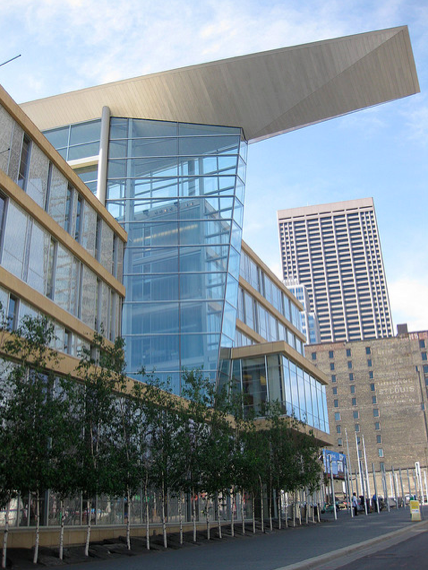
Whether these buildings are really the best examples of postmodern architecture in Minneapolis is definitely debatable. What is notable is that their structural similarities are eclipsed by the prestige of their architects. The term starchitect is often bandied about when speaking of these types of construction: the buildings are not intended to only provide space and shelter, but to inspire community-pride and confidence in the institutions that house them.
Magnificent works of structure are nothing new- the Egyptian Pyramids and cathedrals of Europe have been around for some time. But the shift in elaborate architectural practice from traditional symbols of power and authority to provocative public cultural buildings (opera houses, libraries, and museums) is a relatively recent phenomenon. While it is obvious that financial institutions and corporations produce enormous and impressive skyscrapers, often times these works lack the accessibility and public approval of smaller, creative cultural institutions.
One of the theories of globalization is that as nations become less important, cities will continually be competing to draw resources, people, and talent. As the vitality of manufacturing in these cities decline, new focal points are necessary to differentiate one city (or polis) from another. Does a new focus on avant-garde architecture in public cultural institutions indicate a shift towards a city-state political structure? One that favors culture as the unifying component? Probably not. No one remembers the Acropolis, or the Parthenon, or the Colosseum, right?